

Investment housing credit reaches 8.5% annual growth rate for March 2026
According to the Australian Prudential Regulation Authority (APRA), the Authorised Deposit-taking Institutions (ADIs) reached a combined $2.46 trillion loan book in March 2026. The total housing loan book combines owner-occupied housing loans and investment housing loans. Agile Market Intelligence plotted the publicly available APRA data of the total housing loan books, as well as the owner-occupied and investment loan books to visualise movements in the lending market. Much of this expansion is attributable to growth in their investment loans.
Key stats you need to know
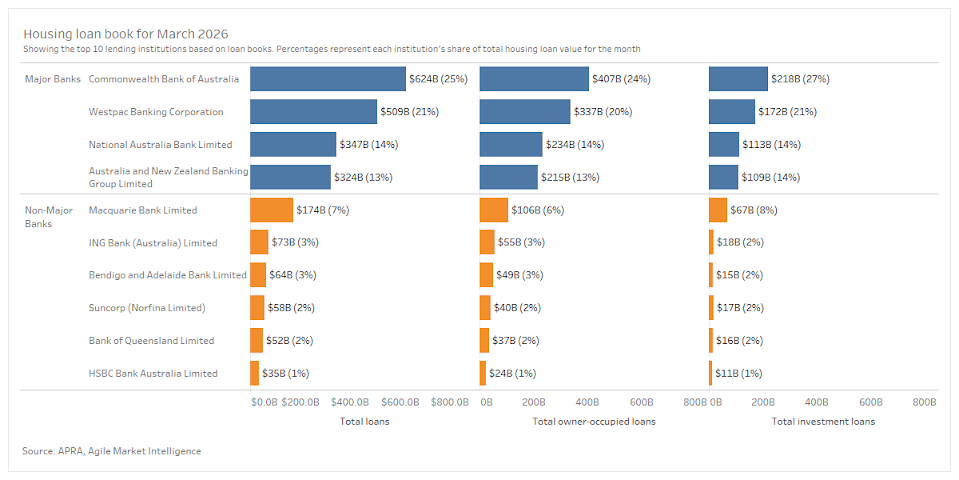
- The top ten ADIs accounted for $2.26 trillion out of $2.46 trillion loan books for March 2026.
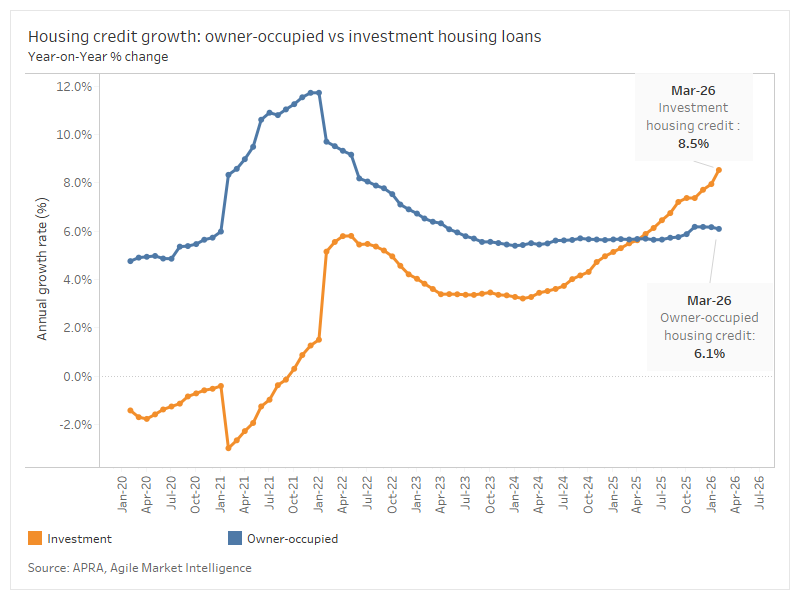
- Investment housing loans have grown 8.5% year-on-year, the highest growth rate recorded since the start of the APRA data collection.
- The big four banks occupy 73% of the total housing loan book share.
In March 2026, the combined total housing loan book for all ADIs reached $2.46 trillion. Loan book growth was slower for the months of January and February 2026, but recovered momentum in March 2026. Currently, the month-on-month growth rate is at 0.57%, with March seeing gains of $13.89 billion.
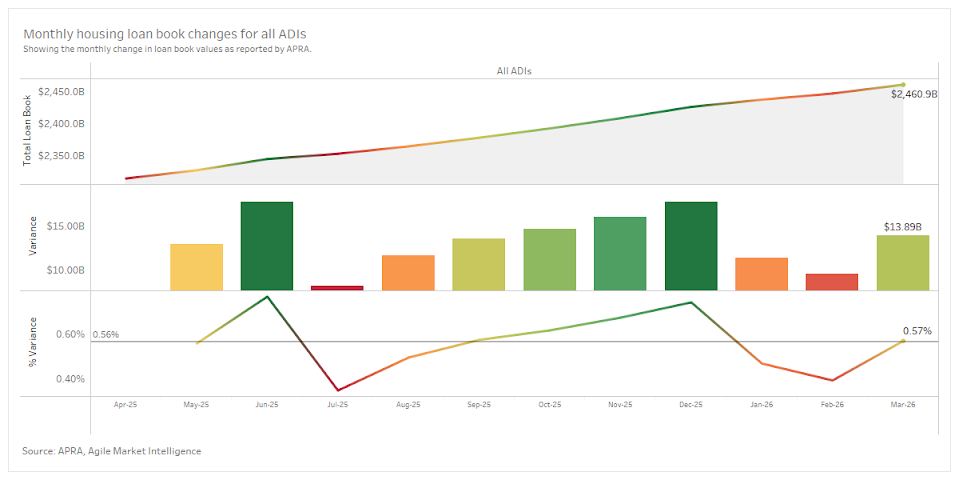
Investment loans attributable to the expansion of the top 10 lending institutions’ loan books
- Macquarie has the largest housing loan book among the non-major banks at $174 billion.
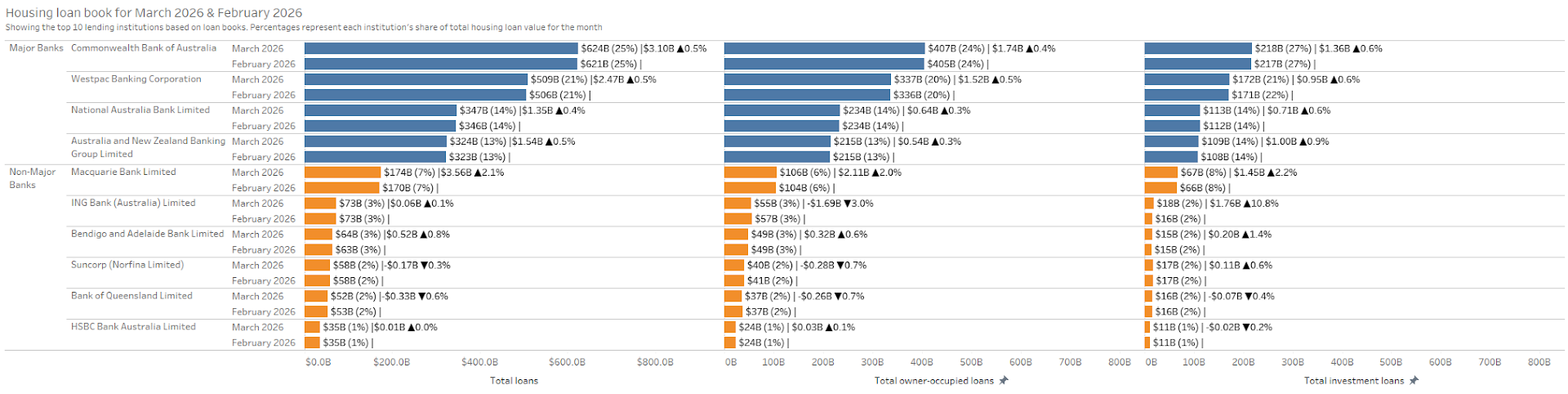
- ING’s investment arm saw a major growth rate month-on-month of 10.8%, despite a -3% decline in its owner-occupier loan book.
For the top 10 lending institutions, the majority of their housing loan books originate from their owner-occupied loans rather than their investment loans. For instance, 60% of Macquarie’s books are covered by owner-occupied loans ($106 billion). For CBA, the bank with the largest loan book, its owner-occupied loans cover 65% of its total shares.
However, in terms of month-on-month changes, investment loans grew at a higher rate compared to their owner-occupied loans. This is true for the major banks, Macquarie, Bendigo and Adelaide Bank Limited, Suncorp, and ING. The latter in particular has seen a major growth jump between February and March 2026 at a rate of 10.8% month-on-month.
Investment housing credit reaches 8.5% annual growth rate
- Annual growth for investment housing loan books accelerated from 6.1% in July 2025 to 8.5% in March 2026.
- Investment mortgage growth has greatly overtaken owner-occupied mortgages since June 2025.
In July 2025, the annual growth rate of investment housing overtook that of owner-occupier loans. Investment housing credit continued to accelerate sharply in the past several months, despite the increase in interest rates at the beginning of 2026. From a 6.1% annual growth rate in July 2025, it climbed up to 8.5% in March 2026, with a particularly sharp spike between February and March. This signals confidence among property investors in a landscape with reduced competition from owner-occupiers.
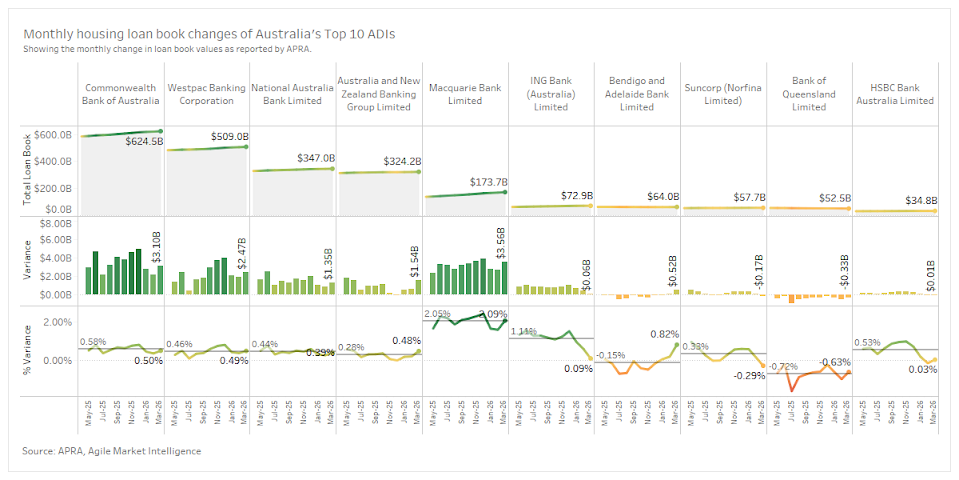
Macquarie reached $3.56 billion growth in March 2026
- CBA contributed the most to the total loan book share at $624.5 billion.
- Macquarie expanded the most with a variance percentage of 2.09%, the highest across the board.
- Similarly, Macquarie grew the most compared to February by $3.56 billion, exceeding that of the major banks.
CBA contributed the most to the total housing loan book share, specifically $624.5 billion. The rest of the major banks similarly contributed the most in terms of total loan book shares, in order, coming up at second would be Westpac ($509 billion), NAB ($347 billion), and then ANZ ($324.2 billion). Interestingly, their growth falls short of the mid-tier bank Macquarie, which reached $3.56 billion more compared to their numbers in the previous month. Their growth rate also exceeds that of the majors at 2.09%. Macquarie is not the only bank to outpace the majors. Bendigo and Adelaide Bank Limited growth rate has rapidly increased in March 2026, having risen up to 0.82%.
About the research
The figures in this article were drawn by Agile Market Intelligence from APRA’s monthly ADI statistics to March 2026. The dataset covers total housing loans segmented into owner-occupied and investment housing loans across the ten largest lenders by mortgage loan book size. For this analysis, Agile plotted publicly available data to show movements in loan books and market share.
Agile Market Intelligence also conducts Broker Pulse, a monthly survey of residential and commercial mortgage lenders. It is a community-driven knowledge base of lender performance that offers transparency to the market by surfacing these collective insights from the broker community. This empowers brokers to make informed decisions and enables lenders to benchmark and improve performance.


.svg%402x.png)










.png)




_100x30%403x.png)




